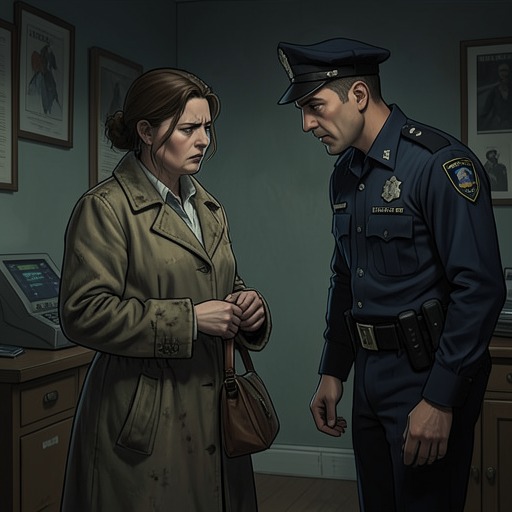
Sarah framed for drug possession
Down Cemetery RoadThe framing of Sarah Trafford for drug possession was an attempt by Axel Crane, operating under the cover identity Rufus, to force her out of her search for Dinah Singleton. The planted cocaine was meant to exploit Sarah’s past and undermine her credibility; when that failed, she remained in danger, while the official and press narratives surrounding her made it harder for her to establish what had happened.
Causes and Background
Sarah’s search began after the bombing of the Singleton house, where Dinah had lived. She went looking for the child with Joe Silvermann, who was killed; Sarah later explained that she was then framed and that, after resuming the search, Rufus tried to kill her. Her account connects the drug charge to a specific chain of events: a missing child, a dead friend, and an effort to prevent her from continuing to ask questions.
The scheme was devised to take Sarah out of the picture by drawing on her background and planting a bag of cocaine. Axel Crane assessed her as a potential problem precisely because she had not responded as expected to intimidation. He considered whether she might be as easily broken as her husband, Mark Trafford, but concluded that she was more likely a fighter than foolish. The failed attempt to discredit her thus became, in his thinking, evidence that she might understand the danger she had entered.
The Charge and Sarah’s Account
When Gerard Inchon asks whether Sarah was caught with drugs, she answers that they were planted and identifies Rufus as the person responsible. Later, she gives the charge its context: she had been looking for the girl from the bombed house, Joe had been killed, and she had been framed; when she began searching again, Rufus tried to kill her. Her voice breaks as she recounts this sequence, and she pauses before continuing. The account is not simply a denial of possession; it is her explanation of why the accusation appeared when it did and what followed from it.
The available account does not specify where or when the drugs were found, how much cocaine was involved, or the precise procedure by which Sarah was caught. What it does establish is the intended mechanism: a planted bag, selected to make her past useful against her, could cast her as an unreliable witness rather than a person investigating the bombing and Dinah’s disappearance. The framing therefore worked through both immediate danger and the credibility that Sarah would need to make her story heard.
The Attempt’s Failure and Its Aftermath
The plan did not remove Sarah from the picture. Axel Crane’s assessment recognizes that the ruse had failed, and Sarah continued searching; she later directly links the planted drugs to that search. But survival did not restore her standing. Zoë Boehm lists Sarah’s drug charge among the reasons she would have little credibility: Sarah had been caught with drugs, her husband was a thief, and the secretive authorities had made Rufus disappear, leaving her unable to prove that he had been near her home.
That catalogue shows how the accusation could keep doing damage after the immediate attempt to stop Sarah had failed. Her account depended on connections—to the bombed house, Joe’s death, and Rufus’s attempt on her life—that others could dismiss or that she could not independently prove. The planted drugs supplied a ready-made reason to distrust her, while the disappearance of Rufus deprived her of a visible suspect against whom she might substantiate the charge.
Public Narrative and Significance
The public story further distorts the facts Sarah is trying to establish. Rufus is officially said not to be dead; the reported account associates him with terrorists, says he used Wigwam as cover and went to ground when exposed, while the press has been told not to print anything about the matter. Zoë also points out that Michael Downey is officially considered dead, and that the body attributed to Thomas Singleton was not Singleton’s, with cremation making proof difficult. These details widen the context beyond Sarah’s individual accusation: disappearance, controlled reporting, and doubtful identifications make the truth unusually hard to demonstrate.
The framing is therefore significant as more than an isolated planted-drug incident. It turns Sarah’s search into a liability by making her own credibility part of the battlefield. The failed attempt to discredit her does not resolve the danger; instead, the charge remains embedded in a public account that obscures the people and events she is trying to expose. The discrepancy between Sarah’s explanation and the story available to others preserves the central uncertainty around Rufus and the missing child, while showing how an accusation can constrain a witness even when it has not silenced her.